
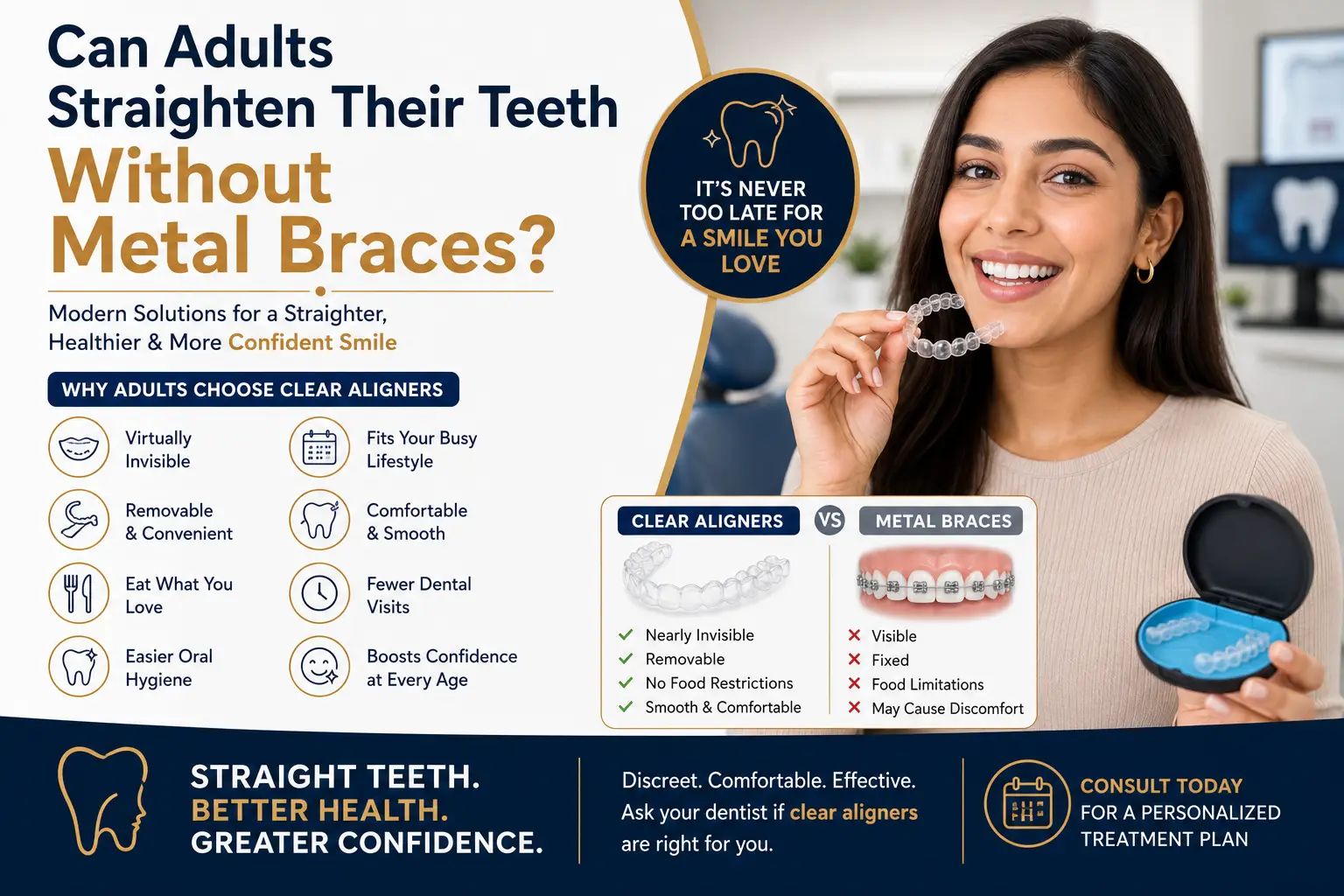
Can Adults Straighten Their Teeth Without Metal Braces?
Can Adults Straighten Their Teeth Without Metal Braces?
A Modern Guide to Clear Aligners, Comfortable Smile Correction & Adult Orthodontic Treatment
By Dr. Faheem Ahmed
For many adults, the desire for straighter teeth doesn’t disappear with age. In fact, it often becomes stronger.
You may have crooked teeth that you’ve lived with for years, gaps that make you conscious when you smile, or teeth that have gradually shifted over time. Perhaps you wanted braces as a teenager but never went ahead with treatment because you didn’t want metal brackets and wires.
The good news is that straightening your teeth as an adult doesn’t necessarily mean wearing traditional metal braces.
Modern dentistry offers discreet alternatives, with clear aligners being one of the most popular options for adults who want to improve their smile while maintaining their normal lifestyle.
But are clear aligners suitable for every adult? How do they work? Are they really better than traditional braces?
Let’s understand what modern teeth-straightening treatment can offer and why more adults are exploring alternatives to metal braces.
Yes, Adults Can Straighten Their Teeth Without Metal Braces
One of the biggest misconceptions about orthodontic treatment is that adults have only two choices: live with crooked teeth or wear traditional metal braces.
That’s no longer the case.
Clear aligners are transparent, removable dental trays that are custom-made to gradually move your teeth into their planned positions.
Instead of brackets and wires, aligner treatment uses a series of specially designed trays. Each set applies controlled pressure to specific teeth, gradually guiding them toward a healthier and more balanced alignment.
For many adults, this approach offers something traditional braces may not:
The ability to straighten their teeth without making orthodontic treatment the centre of attention.
Why Are More Adults Choosing Clear Aligners?
Adults have different priorities compared with teenagers.
A working professional may not want visible braces during meetings. A parent may want treatment that fits around a busy schedule. Someone who frequently attends social events may prefer a discreet option.
Clear aligners address many of these lifestyle concerns.
Here are some of the biggest reasons adults are considering them.
1. They Are Much Less Noticeable
Let’s be honest—appearance matters.
For an adult who has spent years building a professional and social life, the thought of wearing visible metal braces can sometimes be uncomfortable.
Clear aligners are made from transparent material and are designed to fit closely over your teeth.
When worn correctly, they are significantly less noticeable than conventional metal braces.
This can make a difference when you’re:
Attending business meetings
Giving presentations
Meeting clients
Going on dates
Attending weddings or social events
Taking photographs
Speaking in front of people
You can work on your smile without constantly thinking about your braces.
2. They Fit More Easily Into an Adult Lifestyle
Adult life is busy.
Between work, family, travel, social commitments and personal responsibilities, adding a complicated treatment routine may seem overwhelming.
Clear aligners are designed with convenience in mind.
They can be removed when necessary and replaced according to your dentist’s instructions.
This makes them particularly appealing to adults who don’t want orthodontic treatment to interfere significantly with their everyday activities.
However, convenience doesn’t mean you can wear them only occasionally.
Consistency is essential for successful treatment.
Your dentist will provide specific instructions regarding how long you should wear your aligners each day.
3. You Can Eat Normally
One of the common frustrations associated with traditional braces is food restriction.
Certain hard, sticky or chewy foods may need to be avoided because they can damage brackets or wires.
Clear aligners offer more flexibility.
Because they are removable, you can generally take them out before eating and enjoy your meals normally.
After eating, you should clean your teeth and follow your dentist’s instructions before putting the aligners back in.
This means your treatment doesn’t necessarily require you to completely change the way you eat.
4. Maintaining Oral Hygiene Can Be Easier
Keeping teeth clean is extremely important during any orthodontic treatment.
With traditional braces, food particles can become trapped around brackets and wires, making brushing and flossing more challenging.
Clear aligners are removable, allowing you to brush and floss your teeth normally.
This can make daily oral hygiene more convenient.
But remember—the aligners themselves also need to be cleaned properly.
Wearing an aligner over unclean teeth can trap bacteria and food particles against the tooth surface.
Your dentist will guide you on how to clean and care for your aligners.
5. They Can Be More Comfortable for Many Patients
Traditional braces use brackets and wires that can sometimes irritate the cheeks, lips or gums.
Clear aligners have a smooth surface and are custom-designed for the patient’s teeth.
Some patients may experience pressure or mild discomfort when moving to a new set of aligners. This is generally associated with the intended tooth movement.
However, every patient experiences treatment differently.
If an aligner causes significant pain, irritation or doesn’t fit properly, it is important to contact your dentist rather than continuing to wear it without advice.
6. Modern Technology Makes Treatment More Predictable
Clear aligner treatment is closely connected with digital dentistry.
Depending on the case, your dentist may use digital scans, photographs and other diagnostic records to assess your teeth and plan treatment.
Digital planning can help your dentist evaluate:
Tooth position
Spacing
Crowding
Bite relationships
Planned tooth movements
Overall smile appearance
This allows treatment to be planned more precisely and gives patients a better understanding of their proposed smile transformation.
However, a digital simulation is not a guarantee of the exact final result.
Your actual treatment depends on your teeth, bone and gum health, biological response, treatment compliance and other individual factors.
7. Adults Are Not “Too Old” for Teeth Straightening
Another common question is:
“Am I too old to straighten my teeth?”
In most cases, age alone does not prevent an adult from receiving orthodontic treatment.
Healthy teeth can be moved at different stages of adulthood when the supporting gums and bone are healthy and the patient is appropriately assessed.
Adults in their 20s, 30s, 40s, 50s and beyond may consider orthodontic treatment.
What matters is not simply your age.
Your dentist needs to evaluate your:
Teeth
Gums
Bone support
Bite
Existing dental restorations
Oral hygiene
Overall dental health
So if you’ve been thinking, “I should have fixed my teeth years ago,” don’t assume that you’ve missed your opportunity.
8. Clear Aligners Can Address Several Common Alignment Problems
Clear aligners can be suitable for many common orthodontic concerns, depending on their severity and complexity.
These may include:
Crowded Teeth
When there isn’t enough space for teeth to sit properly, they may overlap or appear rotated.
Gaps Between Teeth
Spaces can develop between teeth for several reasons. Certain cases can be corrected through orthodontic treatment.
Crooked Teeth
Teeth that are tilted or rotated may sometimes be gradually aligned.
Certain Bite Problems
Some mild to moderate bite concerns may be managed using aligner treatment, depending on the individual case.
However, not every orthodontic problem can or should be treated with clear aligners alone.
Complex cases may require conventional braces, additional dental procedures or a different treatment approach.
That’s why a professional assessment is essential before choosing an aligner treatment.
9. You Can Remove Them for Important Occasions
Imagine having an important presentation, wedding, family function or special photograph coming up.
One of the advantages of removable aligners is that they can be taken out when necessary, according to your dentist’s instructions.
This gives adults a level of flexibility that fixed braces don’t provide.
But there is an important point:
Don’t confuse removable with optional.
Taking your aligners out too frequently or wearing them for significantly less time than recommended can affect treatment progress.
The best results come from following your prescribed wear schedule consistently.
10. A Straighter Smile Isn’t Just About Appearance
Many adults consider orthodontic treatment because they want a more attractive smile.
That’s perfectly understandable.
But properly aligned teeth can also make certain aspects of oral hygiene easier and may contribute to better functional balance in appropriate cases.
Straightening treatment may help address issues associated with:
Crowding
Difficult-to-clean areas
Certain bite problems
Uneven tooth contact
Tooth positioning
However, orthodontic treatment is not a substitute for good oral hygiene.
Even perfectly straight teeth still need daily brushing, flossing and regular dental checkups.
Clear Aligners vs Metal Braces: Which Is Better?
There isn’t one treatment that is automatically better for everyone.
The right choice depends on your dental condition, treatment goals, lifestyle and clinical requirements.
Clear Aligners
Advantages may include:
Nearly invisible appearance
Removable design
Easier access for brushing and flossing
Fewer food restrictions
Convenient for many adults
Digital treatment planning
Traditional Braces
Advantages may include:
Suitable for a wide range of orthodontic problems
Fixed treatment means patients don’t need to remember to put them back in
Can be highly effective for complex tooth movements
The important question isn’t:
“Which treatment is more popular?”
The better question is:
“Which treatment is appropriate for my teeth?”
That answer should come after a professional dental and orthodontic assessment.
How Long Does Adult Clear Aligner Treatment Take?
There is no single treatment duration that applies to every adult.
Treatment time depends on factors such as:
Degree of crowding
Tooth movement required
Bite correction
Number of teeth involved
Patient compliance
Biological response
Complexity of the case
Some relatively simple cases may require a shorter treatment period, while more complex cases can take considerably longer.
Your dentist can give you a more meaningful estimate after examining your teeth and creating an individualized treatment plan.
Are Clear Aligners Suitable for Everyone?
No.
This is an important point.
Clear aligners are an excellent option for many patients, but they are not automatically suitable for every person or every dental problem.
Before starting treatment, your dentist should evaluate your oral health.
Active dental problems such as untreated cavities or gum disease may need to be addressed first.
Your dentist will also assess whether the planned tooth movements can be achieved safely and predictably using aligners.
Sometimes another treatment option may be more appropriate.
The goal should never be to choose aligners simply because they are fashionable.
The goal is to choose the treatment that is right for your smile.
What Happens During a Clear Aligner Consultation?
If you’re considering clear aligners, your first appointment is an important step.
Your dentist may assess:
Your teeth and gums
Your bite
Tooth crowding or spacing
Existing dental restorations
Oral hygiene
Your smile goals
Depending on your case, diagnostic records such as photographs, X-rays or digital scans may be recommended.
Once your dental condition has been assessed, your dentist can explain whether clear aligners are appropriate and discuss the expected treatment process.
This personalized approach is much safer than choosing an aligner treatment based only on an online advertisement or a generic smile simulation.
What Happens After Your Teeth Are Straight?
Getting your teeth into their new positions is only part of the journey.
After active orthodontic treatment, retention is essential.
Teeth can naturally shift over time, which is why retainers are commonly prescribed after orthodontic treatment.
Your dentist will recommend an appropriate retention plan based on your individual case.
Think of it this way:
Aligners move your teeth. Retainers help maintain the result.
Skipping the retention phase can increase the risk of your teeth shifting again.
Common Myths About Adult Clear Aligners
Myth 1: “Adults Can’t Straighten Their Teeth.”
Reality: Adults can often undergo orthodontic treatment when their teeth and supporting tissues are healthy and treatment is clinically appropriate.
Myth 2: “Clear Aligners Work for Every Case.”
Reality: Clear aligners can treat many cases, but some complex conditions may require traditional braces or other treatment approaches.
Myth 3: “Clear Aligners Don’t Need Discipline.”
Reality: Because aligners are removable, patient compliance is extremely important.
Myth 4: “If My Teeth Look Straight, I Don’t Need Retainers.”
Reality: Teeth can shift after treatment. Retention is an important part of maintaining your result.
Myth 5: “Orthodontic Treatment Is Only Cosmetic.”
Reality: While improving the appearance of your smile is an important goal for many patients, orthodontic treatment can also address certain functional and bite-related concerns.
When Should You Consider Straightening Your Teeth?
You may want to discuss orthodontic treatment with your dentist if you have:
Crowded teeth
Gaps between teeth
Crooked or rotated teeth
Teeth that have shifted over time
Certain bite problems
Difficulty cleaning specific areas because of crowding
Concerns about your smile
You don’t have to wait until a dental problem becomes painful before asking about treatment.
A consultation can simply help you understand your options.
There is no obligation to start treatment immediately.
Final Thoughts
So, can adults straighten their teeth without metal braces?
For many adults, the answer is yes.
Clear aligners have changed the way people think about orthodontic treatment. Their discreet appearance, removability and convenience make them an attractive option for adults who want to improve their smile without traditional metal brackets and wires.
But remember—clear aligners aren’t a one-size-fits-all solution.
Every smile is different.
The best treatment is the one that is carefully selected according to your dental health, tooth position, bite, treatment goals and lifestyle.
If you’ve spent years thinking, “I wish my teeth were straighter,” you don’t necessarily have to keep postponing that decision.
Modern dentistry gives adults more choices than ever before.
About Dr. Faheem Ahmed
Dr. Faheem Ahmed focuses on comprehensive, patient-centered dental care and personalized treatment planning. His approach is to understand each patient’s dental needs and goals before recommending the most appropriate treatment option.
Your smile doesn’t have to fit a standard treatment plan. Your treatment should fit your smile.
Leave a Reply