
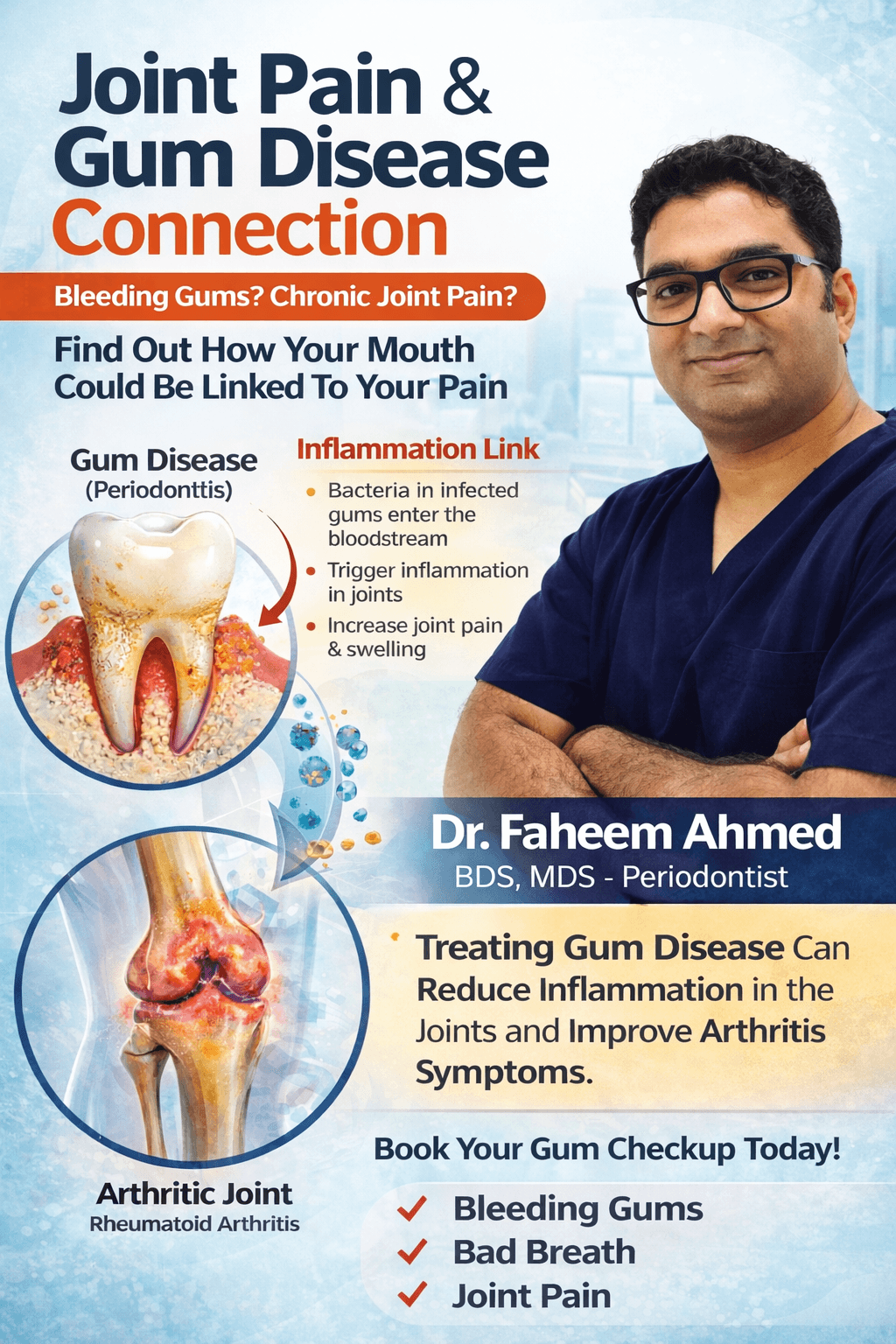
Joint Pain & Gum Disease Connection | Dr. Faheem Ahmed
Joint Pain? Your Gums Might Be the Hidden Cause – Dr. Faheem Ahmed Explains
Most people think joint pain comes only from age, arthritis, calcium deficiency, or weight issues. But what if the real problem is not in your knees, shoulders, or ankles? What if it starts inside your mouth? Yes, you read that right. Recent studies and medical experts are now highlighting a strong link between gum disease (periodontitis) and joint pain, especially conditions like rheumatoid arthritis.
As a dentist, I, Dr. Faheem Ahmed, often meet patients who come for bleeding gums or bad breath—but later reveal they also suffer from chronic body aches and joint stiffness. And that’s where things get interesting.
Let’s break this down in a simple, clear, and practical way.
The Mouth-Joint Connection: What Most People Don’t Know
Your mouth is not separate from your body. It’s the entry gate.
When your gums are healthy, they protect you. But when your gums are infected, bacteria can travel into your bloodstream and cause inflammation in other areas including your joints.
This is exactly why doctors today are saying:
“Management of oral health is integral to arthritis care.”
And this is not just a social media claim it is backed by research.
What is Gum Disease (Periodontitis)?
Gum disease is a long-term infection of the gums caused by plaque and bacteria buildup.
It often begins as gingivitis and slowly progresses into periodontitis.
Common symptoms include:
Bleeding while brushing
Swollen or red gums
Bad breath that doesn’t go away
Loose teeth
Pain while chewing
Gum recession (teeth looking longer)
The problem is, most people ignore these symptoms until the damage becomes severe.
How Gum Disease Can Cause Joint Pain
Let’s make it very simple.
When you have gum disease, harmful bacteria live around your teeth and gums. One of the most common bacteria involved is:
Porphyromonas gingivalis
This bacteria is widely known to trigger chronic inflammation.
Once it enters the bloodstream, it can reach different parts of the body, including the joints.
This may lead to:
Increased inflammation in joints
Joint stiffness and swelling
Pain during movement
Worsening of rheumatoid arthritis symptoms
This is why gum infections are sometimes called “silent inflammatory triggers.”
The Inflammation Link: Why It Matters
Inflammation is the root cause of many chronic diseases.
Periodontitis creates inflammation in the mouth. But the body does not keep it limited there.
The infection can raise inflammatory markers and contribute to problems like:
Rheumatoid arthritis
Diabetes
Heart disease
Respiratory infections
Weakened immunity
So when you treat gum disease, you are not only saving teeth—you are improving overall body health.
Can Gum Disease Trigger Rheumatoid Arthritis?
Rheumatoid arthritis (RA) is an autoimmune condition where the immune system attacks the joints.
Studies suggest that gum bacteria can trigger a process called citrullination, which can confuse the immune system and worsen RA.
In simple words:
Your immune system gets activated unnecessarily and starts attacking your own joint tissues.
That’s why many RA patients are now advised to get a dental checkup as part of their arthritis management.
Why Joint Pain Patients Should Get Their Gums Checked
If you have joint pain and you also notice:
Bleeding gums
Bad breath
Loose teeth
Swollen gums
Frequent mouth ulcers
Yellow tartar deposits
Then your gums might be contributing to your joint inflammation.
Many patients keep taking painkillers for years without realizing the root trigger could be hidden in the mouth.
What Research Says About Gum Disease in India
According to health reports, more than 80% of Indians have some form of gum disease.
That means gum infection is extremely common, yet rarely treated seriously.
And rheumatoid arthritis affects millions of Indians as well. So the overlap is large.
That’s why awareness is important.
Can Treating Gum Disease Reduce Joint Pain?
In many cases, yes.
When gum infection is treated, inflammation reduces in the body. This can help patients experience:
Less joint stiffness
Reduced swelling
Better mobility
Improved response to arthritis medicines
Of course, gum treatment is not a “magic cure” for arthritis. But it can become a powerful support therapy.
Think of it like this:
If you remove the infection source, the body fights less.
Signs You Need Gum Treatment Immediately
You should consult a dentist if you notice:
1. Bleeding while brushing
This is never normal.
2. Bad breath even after mouthwash
It could be infection under the gums.
3. Gum swelling or pus discharge
This is a sign of advanced periodontitis.
4. Teeth feeling loose
Bone support may already be affected.
5. Pain in gums while chewing
This indicates deep infection.
Best Dental Treatments for Gum Disease
At our clinic, gum disease is treated through professional procedures such as:
1. Scaling and Root Planing
This is deep cleaning below the gum line to remove:
Plaque
Tartar
Infection-causing bacteria
2. Gum Pocket Cleaning
If pockets are deep, additional cleaning is required.
3. Laser Gum Therapy (if needed)
A modern and comfortable option for severe cases.
4. Maintenance Visits
Gum disease needs follow-up to prevent recurrence.
Daily Habits to Protect Your Gums and Joints
If you want strong gums and a healthier body, follow these simple habits:
Brush twice daily
Use a soft toothbrush
Floss regularly
Use an antibacterial mouthwash (as advised)
Avoid smoking or tobacco
Reduce sugar intake
Drink plenty of water
Get scaling every 6 months (or as recommended)
Remember: Gum disease does not heal on its own.
Can Bad Teeth or Infection Affect Body Pain?
Yes. A dental infection is not just a tooth problem—it is a bacterial problem.
Chronic infection increases inflammation, which can worsen:
joint pain
fatigue
headaches
diabetes control
heart health
So if you are tired of unexplained body pain, start by checking your mouth.
Dr. Faheem Ahmed’s Advice
If you have persistent joint pain, don’t just treat the symptoms.
Ask yourself:
Do my gums bleed?
Do I have bad breath?
Do my teeth feel weak or loose?
If yes, then it is time to consult a dentist.
Because sometimes, the pain in your knees is not coming from your knees.
It’s coming from your gums.
Final Words: Your Mouth Can Affect Your Whole Body
Joint pain is not always only about bones or age.
Your oral health plays a major role in your overall health.
So the next time someone says:
“I have arthritis, what can a dentist do?”
The answer is simple:
A lot.
Treating gum disease can reduce inflammation, improve immunity, and support better arthritis management.
Book Your Gum Checkup with Dr. Faheem Ahmed
If you are facing gum bleeding, swelling, bad breath, or joint pain along with oral symptoms, consult Dr. Faheem Ahmed for a complete dental evaluation.
A healthy mouth is not just about a beautiful smile—it is about a healthier body.
Leave a Reply